Charm (Dawkins)
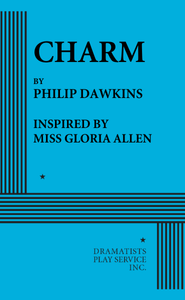
by Philip Dawkins

Highlights
What readers are saying
Readers appreciate the heartfelt narrative and themes of community in the play. Many highlight its portrayal of LGBTQ+ experiences and character development, despite some challenges in engagement early on. Overall, it is seen as a beautiful fairy tale that resonates with its audience.
Synopsis
When Mama Darleena Andrews – a 67-year-old Black, transgender woman – takes it upon herself to teach an etiquette class at Chicago’s LGBTQ community center, the idealistic teachings of Emily Post clash with the very real-life challenges of identity, poverty and prejudice faced by her students.
Inspired by the true story of Miss Gloria Allen and her work at Chicago’s Center on Halsted, Charm asks: How do we lift each other up when the world wants to tear us down?
Press Reviews
"An uplifting LGTBQ fairy tale… [an] urgent dialogue about identification and acceptance… Charm is a celebration, a story rooted in reality but touched with a kind of optimist fantasy: It is attempting to create the world it wants us to live in."
— New York Magazine
"[A] funny, heart-warming play… [a] bona-fide charmer… The playwright’s command of language puts a nice kick in his dialogue."
— Variety
"Bold and tender… Charm is inspired by the real-life work of Miss Gloria Allen, but it is richer and more complex than mere homage. Dawkins… juggle[s] a colorful array of characters with skill."
— Time Out New York
"That rare play that is simultaneously funny, smart, and emotionally gripping… Dawkins leaves us swimming in crucially relevant questions: At what point does etiquette become less about fostering comfort and respect, and more about enforcing an exclusionary class system?… Charm exercises our brains, [hearts], and our funny bones, resulting in a very satisfying night at the theatre."
— TheaterMania
Characters
| Character |
|---|
MAMA DARLEENA ANDREWS 67. African American. Trans woman. Pronoun: She. A former nurse, Chicago born and raised. She is of a certain era now long gone. She somehow manages to be classy and charming even in six-inch gator-skin heels. She’s got class and she’s got sass, both in equal proportions. And opinions, she’s got those too. She’s not afraid to tell it how she sees it. Retired now, she could use a little community of her own, and she thinks the tacky, uncouth kids at the Center could benefit quite nicely from her company. |
ARIELA 33. Puerto Rican American. Trans woman. Pronoun: She. She is a stunning woman. What she lacks in conventional good taste, she makes up for in natural beauty. No high school education, Ariela has spent most of her life turning tricks on the streets of Boystown, and she knows how to take care of herself. A definite chip on her shoulder about being lumped into this group with so many kids, still she attends Mama’s Charm Class voluntarily, mostly to see Mama. She has a vicious tongue, and don’t you dare cross her. There’s a reason she’s still alive after more than twenty years on the street. She survives. She’s recently made an active decision to turn her life around, and is in the process of getting out of The Life and making healthier choices. |
JONELLE (Pronounced “John L.”) 19. Any ethnicity, not white. Trans woman, gender nonconforming, nonbinary or genderqueer. Pronoun: She. Jonelle, though assigned “male” at birth, is more comfortable expressing herself with feminine terms and clothing (which she wears quite well). She’s experimenting with her gender expression and hasn’t yet landed on any over another, if in fact she plans to at all. She’s smart – sometimesflaunts it – and is currently finishing her first year at a community college in Uptown. Dry, sardonic, already over it. She comes from a rough background but finally found her way into a supportive foster home that helped her get out of a bad situation. Now her life is on track, but she can “turn street” at the drop of a hat and gladly. Over the course of this play, she’ll start to discover that she’s a natural nurturer/caregiver. |
VICTORIA 23. African American. Heterosexual, cisgender woman. Pronoun: She. Experiencing homelessness. Mother of two young kids who live with her grandma. She’s kind, gregarious, energetic and generous even though she has nothing. In a relationship with her babydaddy, Donnie. She isn’t bright, but she’s loyal and a hard worker. Victoria is overweight and has trouble with hygiene. Victoria will always put other people’s needs before her own, to a fault. |
DONNIE 21. African American. “Mostly” heterosexual, cisgender man. Pronoun: He. Experiencing homelessness. Victoria’s babydaddy. He has no education or job and no desire to change his situation. Defensive and overly sensitive, he can dish it out but can’t take it. Mostly, he dishes it out to Victoria. Donnie is threatened by anyone he perceives is trying to show him up. Likes to clown around. |
BETA 20ish. African American. Male-identifying; nobody knows that he is a trans man. Pronoun: He. A gangbanger. Thuglife from head to toe. Dresses all in black with dark sunglasses a permanent fixture on his face. He’s quiet and mysterious, the last flame in a scorched field. A dark mystery to most people. His intentions for coming to Charm are unclear, but his history of violence and his association with danger are well known to everyone. |
LADY Early 20s. Any ethnicity. Trans woman, gender nonconforming, nonbinary or genderqueer. Pronoun: She. Assigned a male gender at birth, Lady is having a really hard time expressing her gender to the world successfully. Her long hair is confounded by the fact that she is going rather quickly and badly bald on top in a typically “male” way. She’s not conventionally attractive and has trouble sifting through the Goodwill bin to find something that helps her body look remotely feminine. Lady is a person living with autism as well as other undiagnosed illnesses. She has run away from her assisted-living situation in another state to come live in some awful, public housing for people with mental disabilities on the far West Side of Chicago. She has no friends, no family and nowhere to go outside of her public housing and the Center. |
LOGAN 18. Any ethnicity. Cisgender gay man, but very androgynous. Pronoun: He. A pretty kid. Comes from money and privilege and reeks of it. He’s been told he is smart. A lot. He’s lacking in charm in his own myopic way, but he recognizes on some inexplicable level that he belongs in Mama’s Charm School. At the same time, there’s almost nowhere he could possibly be more out of place. |
Videos
Charm – MCC Theater Trailer
Publication
Charm (Dawkins) is a lgbtq play written by Philip Dawkins and published by Dramatists Play Service (2018).
Community Reviews
No community reviews yet
Buy Play

From £38.87 total
New
Performance Rights

Similar Plays
Plays with similar themes, style, and content.







More from Philip Dawkins
More plays from Philip Dawkins that we think you'll enjoy.