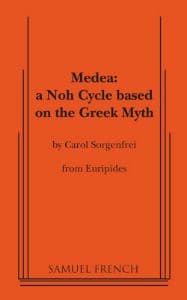
Medea: a Noh Cycle Based on the Greek Myth
by Euripides, Carol Sorgenfrei

Synopsis
How could a woman who killed her children be saved by the gods?
The shocking ending of Euripides' play is the starting point for a meditation on modern woman and the role of the artist/shaman.
This synthesis of classic Greek and Japanese Noh Theatre retains the basic story of the former but is performed in a creative, stylized manner inspired by the latter, with chant, song and dance.
These two theatre forms have many similarities - both are non-illusionistic and both grew out of religious ceremony and ritual - drawing on primitive myths and legends.
In Japan the Noh plays have no thematic relation, but this play consists of five scenes - each corresponding to one of the traditional plays to form a single entity.
This work offers exceptional opportunities for creativity and artistic innovation to directors, actors and designers.
Press Reviews
"...an arrestingly dramatic production.... a hypnotic mood of sacred ritual... gripping..."
— StarTribune, Minneapolis-St. Paul
"Strikingly fresh ... theatrically arresting ... striking achievement."
— Washington Post
Characters
| Character |
|---|
Jason an ambitious "hero" who owes everything to the intervention of the gods and the help of Medea, revealed to be a demon in disguise |
Nurse timid, conventional and loyal, but eventually discovers her own strength as a woman |
Creusa a simpering, vain, unaware princess |
Chorus Members require exceptional speaking voices |
Children cloying and grasping, played by non-speaking dancers able to enact various other roles (ex: magic bulls) |
Medea strong-willed woman, artist-shaman, sexual, an outsider revealed to be a goddess |
Publication
Medea: a Noh Cycle Based on the Greek Myth is a play written by Euripides and published by Samuel French (1975).
Community Reviews
No community reviews yet
Buy Play
Performance Rights
Restrictions: Major Markets Only (US) / Standard Restriction (UK)
Apply for Rights
Similar Plays
Plays with similar themes, style, and content.







More from Euripides
More plays from Euripides that we think you'll enjoy.