
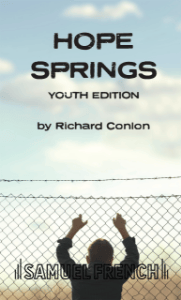
Hope Springs: Youth Edition
by Richard Conlon

Highlights
Synopsis
When all communications are lost with a privately run youth correction facility, two educational inspectors head off to the facility’s remote island location to work out what has happened.
They get more than they bargained for in this tale exploring big issues for young people.
Sent to the island for “behavior modification,” some of the pupils staged a rebellion sparked by a singular dramatic event, while others simply wanted to keep their heads down and leave after they’d gone through “the program.”
This text will spark not only strong performances from teenagers, but also debates about the rights and wrongs in the script – inspiring readers and performers to ask the question: “What would I have done?” This version of Hope Springs is adapted for younger actors; it touches on some big themes but addresses them more obliquely than the more hard-hitting original.
Press Reviews
"A dark and complex play... Hope Springs asks a lot of questions about family relationships, child abuse and behavioural problems."
— ArtSmart
Characters
| Character |
|---|
The Principal Brisk, cold and businesslike, but should not be played as evil or malevolent. |
The Ringleader Intelligent, charming and charismatic, quick to anger and cool. |
The Inspector Has a natural authority, observant with keen judgement. |
The Assistant A little slow-witted, but not a buffoon. |
Pupil 1 Used to getting what they want through their looks and charm – a flirt. |
Pupil 2 Street wise and assured. Cocky, almost to the point of aggression. |
Pupil 3 Idealistic, principled and thoughtful. |
Pupil 4 Mercurial, creative, sardonic. |
Pupil 5 A thief and a liar, with an aggression just barely below the surface. |
Pupil 6 A little disgruntled that their plan of ‘working hard and getting out’ has been disrupted. |
Pupil 7 The ideal kind of pupil for the institution – wants to complete the programme and get out as quickly as possible. |
Pupil 8 Joyfully belligerent about the institution – refuses to be cowed or broken. |
Island Voices 1–6 Are the CHORUS of the piece and can slip in and out of being observers, scene-setters and characters in their own right. |
Parents 1–6 Should not be shown to be monsters, they need to seem to have few options left. |
Staff 1 &Amp; 2 Manipulative and divisive.*PUPIL – In the script, the asterisk before pupil indicates that these lines can be given to one pupil or shared between two, three, four or five pupils, depending on the needs of the cast.AUTHOR’S NOTE: The text is gender-neutral throughout and can be approached by casts of either gender, any mix of both, or indeed any non-binary actor. This same simple principle also extends to ethnicity. Needless to say, casting throws up interesting debates about the politics of the everyday and can shine new light on the lines. I hope this approach to writing the piece means teachers and directors can give the most appropriate part to the most suitable performer. |
Sam Sensitive and thoughtful, prone to melancholy. |
Publication
Hope Springs: Youth Edition is a play written by Richard Conlon and published by Samuel French (2024).
Community Reviews
No community reviews yet
Buy Play
Performance Rights
Restrictions: Not Restricted (US) / No Restrictions (UK)
Apply for Rights

Similar Plays
Plays with similar themes, style, and content.


More from Richard Conlon
More plays from Richard Conlon that we think you'll enjoy.