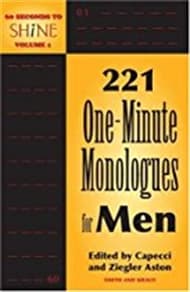
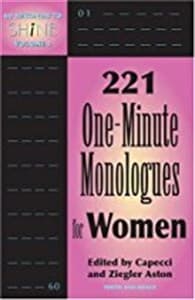
60 Seconds to Shine Volume 2: 221 One-minute Monologues For Women

Synopsis
From the Inside Flap Upon learning of today’s typical cattle-call audition process, Dustin Hoffman—who hasn’t had to audition in a long, long time—once declared that if he had only a minute to make an impression, he’d take off his clothes.
For those of us who would rather think inside the box, here are two hundred and twenty-one monologues, all one minute or under in performance length.
For those auditions or class assignments where brevity is crucial, you need a monologue that gets to the point.
You need a defined character, strong emotional content, and a resonant ending.
Just as important, you need a lot of monologues from which to choose.
This book offers you that, and more.
In our continuing effort to offer you new sources of monologues, we’ve drawn from plays, novels, short stories, poems, original monologues, essays, comics, novellas, radio plays, film scripts, and personal narratives.
How to Use This Book.
At the back of this volume, you’ll find all 221 monologues indexed according to age, tone, and voice, to help identify those most suited to your needs: Age is noted exactly only when specified by the author.
More often, we’ve indicated an age range (20s, 20s-30s).
In some instances, we’ve used a plus sign to show the character could be older than indicated, as in 40+.
Classic/Contemporary refers to when the monologue was written, not necessarily when the character is speaking.
"Classic" texts are those that were written prior to the early 1920s.
Voice refers to indications of class, geography, ethnicity, nationality, sexual identity, or physicality that may help performers gain entry into an individual character, or closely "match" themselves to a monologue.
The language of any text will reveal a certain level of education, class, or knowledge.
Sometimes, however, a monologue arises out of specific cultural experience, demonstrated either through content or language.
Those are the selections you’ll find listed in the "Voice" index.
Whenever possible, we’ve attempted to excerpt monologues with a minimum of editing.
Where editing was necessary, omissions are indicated by parenthetical ellipses ( .
.
.
). All other ellipses were part of the original text.
We offer appropriately brief contexts to help you gain some entry into the monologues.
But, of course, in order to fully understand and ultimately embody the characters, you are strongly advised to read the play, novel, poem, etc. from which the monologue was drawn.
The greater context must be fully explored in order to answer the all-important questions: who, what, when, where, why.
So—go forth and be brief.
Just keep your shirt on.
About the Author JOHN CAPECCI holds a Ph.D. in Speech Communication and has nearly twenty years experience coaching, teaching, and presenting public performances.
He is an editor, along with Irene Ziegler Aston, of 60 Seconds to Shine Volume 1: 221 One-Minute Monologues for Men; 60 Seconds to Shine Volume 2: 221 One-Minute Monologues for Women; 60 Seconds to Shine Volume 4: 161 One-Minute Monologues from Literature; 60 Seconds to Shine Volume 6: 221 One-Minute Monologues from Classic Plays; The Ultimate Audition Book 2: 222 Monologues from Literature, Two Minutes & Under; The Ultimate Audition Book 3: 222 Monologues, Two Minutes & Under from the Movies; and The Ultimate Audition Book 4: 222 Comedy Monologues, Two Minutes & Under .
IRENE ZIEGLER ASTON is an actor, teacher, playwright, and novelist.
She has taught speech, oral interpretation, and acting at Eastern Michigan University, and the University of Richmond, where she was an Artist in Residence.
Publication
60 Seconds to Shine Volume 2: 221 One-minute Monologues For Women is a play written by and published by Samuel French (2006).
Community Reviews
No community reviews yet
Buy Play

From C$7.40
New · Used

Similar Plays
Plays with similar themes, style, and content.